Basic Whey Bread Rolls

Today I used up some of my yoghurt whey to make some tasty dinner rolls. I thought it might be fun to present this as a pictorial how-to, rather than a “recipe”. Enjoy! šŸ„–


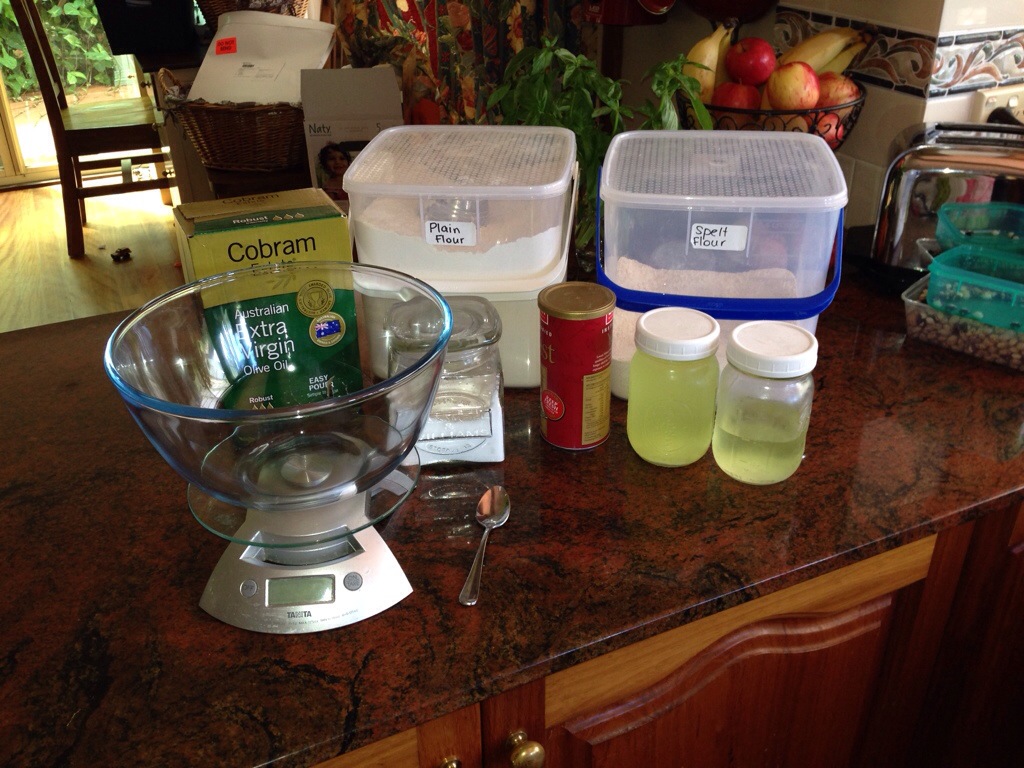
Ingredients for making whey bread

These are the ingredients for basic bread: baker’s flour, liquid (yoghurt whey in my case), salt, yeast and oil.
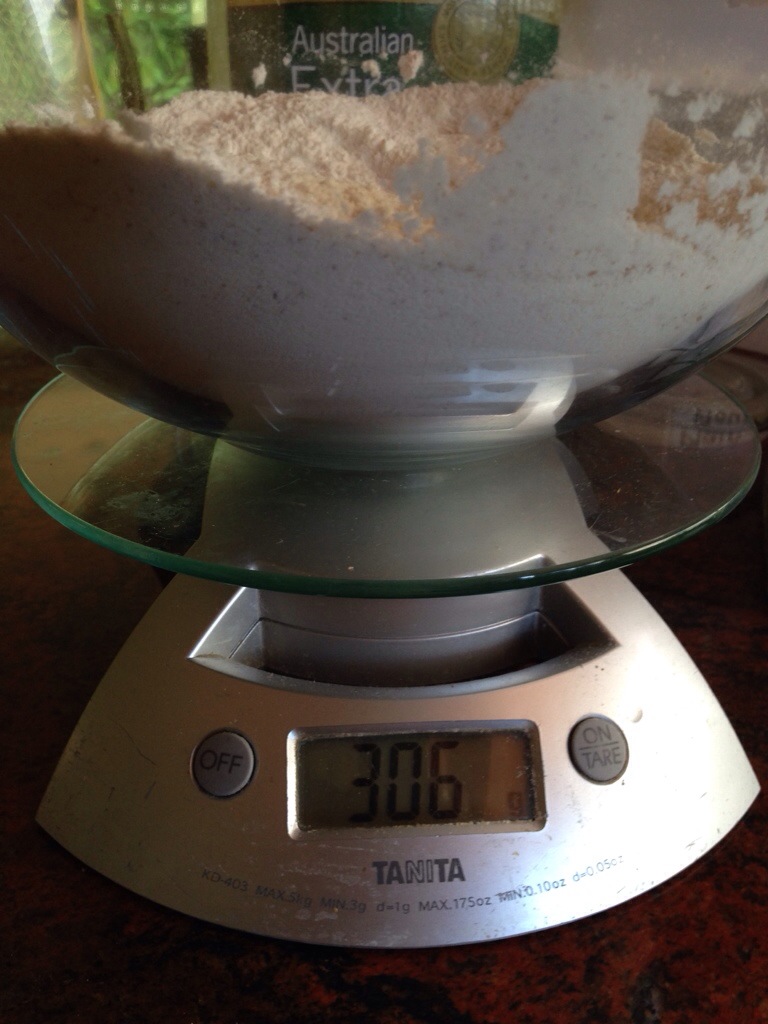
Measure your flour by weight

First measure out 300 grams flour. I combine organic wholemeal spelt with regular organic plain baker’s flour. I use organic because it’s great quality, and I buy it in mega-bulk so it’s cheaper than the regular stuff at the supermarket. When choosing your flour, make sure it is high in gluten, for the best result. Regular “plain flour” (ie. cake flour) is not a great choice for making bread.
One teaspoon salt

Add 1 teaspoon of salt …

Add 1 1/2 teaspoons yeast

… and then 1 ½ teaspoons of yeast.

Mixing dry ingredients

Then mix the dry ingredients up and make a well in the centre.
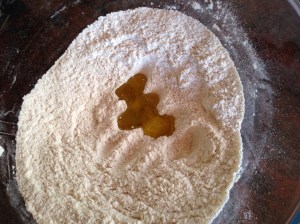
About a tablespoon of oil

Pour in about a tablespoon of oil (I just do it by eye).
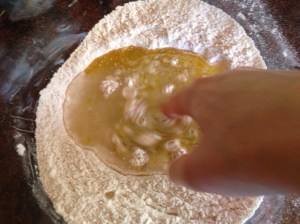
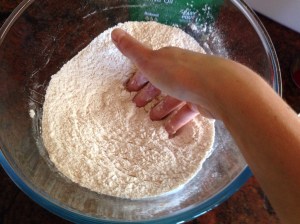
Swirl the liquid with your finger

Then you add 200 grams of your liquid, in my case, leftover yoghurt whey. I make sure the liquid is slightly warm (not too hot — less than blood temperature — or it will kill your yeast, and your bread will be flat). I start swirling the liquid in the centre of the well, and as it swirls it starts taking up some flour from underneath.
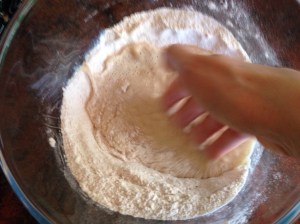
Stirring liquid into flour

After some more stirring it looks a bit like pancake batter …
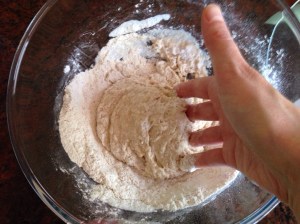
Flour heaping up

And more, and it comes together.

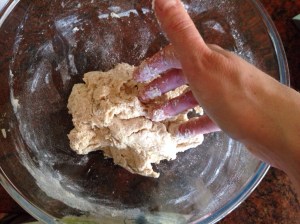
Sticky dough

Finally, you have a rather sticky bit of dough. Notice how clean my bowl is? That’s because I have refined this stirring technique after a lot of practice. If you avoid the liquid touching the bowl, you avoid a bunch of mess. šŸ™‚

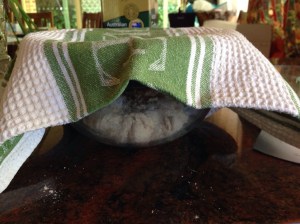
Dough covered with a tea towel

Cover it up with a tea towel, and leave it for a while. I went and mucked out the chicken coop, so I think it was about half an hour. You might choose to do something more salubrious: maybe a cup of tea? ā˜•ļøšŸ«–

Turn the dough out onto a floured work surface

After your dough has finished “resting”, uncover it. It might look slightly less sticky, now. Turn it out onto a lightly floured surface, and knead it (there’s not “right” way to knead. Just go to town and stretch it, fold it, push it, whatever you want). If you didn’t rest the dough, it will be very sticky and you will need to keep putting flour on your surface and your hands. Resting the dough gives it a chance for the flour to absorb some of the liquid you added, making it more like dough, and less like taffy! šŸ™‚

Dough ready to rise

When it feels stretchier (and it won’t need too much because you let it rest first), form it up into a ball and pop it back into the bowl.
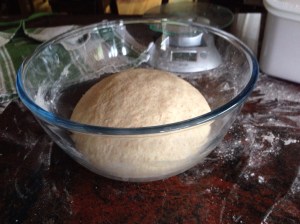
Dough doubled in size

Cover and leave it to rise for a while now, until it “doubles in size”. This is a very woolly recommendation, and I feel a bit squirmy perpetuating this one, but you are just going to have to practice until you get the right amount of rising.

I’ve seen a cute idea for a more measurable approach: pull off a small chunk of dough and squash it into the bottom of a cylindrical glass jar. Mark the jar at the height of the dough, and mark where you think “double” height should be. Then you check the jar periodically until the dough reaches the second mark. Never tried it! Sounds neat though.

After a couple of hours (in my warmish early autumn kitchen — longer if it’s cold) it’s ready to knock back. Get it out of the bowl again onto a floured surface, and lightly poke it all over so that the gas comes squishing out (a bit). Be gentle, because now your dough is almost ready to bake, and it wants to be treated nicely. You can let it rest for a minute or so, but I’m too impatient, so I just shape it straight away.
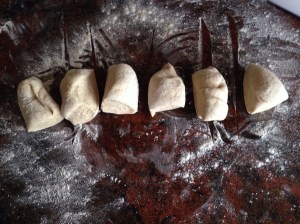
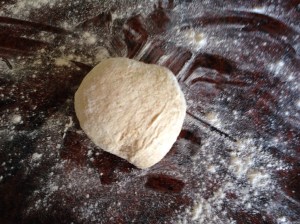
Cut dough into six pieces

I cut it up using my “dough cutter / scraper” (which is one the the most awesome bread tools I’ve ever used). A sharp knife works too.
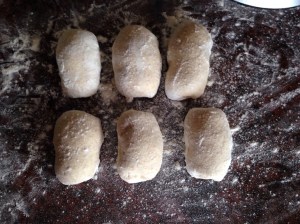
Shaped dinner rolls

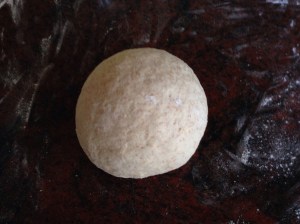
Fold each shape over and over, turning it as you go, so that it forms a nicely rounded ball. I elongated mine to make a dinner roll.

Rest shaped rolls under a tea towel

Make sure the bottom of each roll is well dusted with flour, and lightly floured on top, then cover and rest on your bench (or wherever) until it’s time to bake (it took about twenty five minutes today).

My baking stone

As soon as I’ve shaped the rolls I get the oven ready. I dust off my baking stone (it lives in the oven unless I want to bake something like a roast, which uses lots of shelves), and wipe out any stray crumbs from last baking. And I pre-heat to at least 220 °C. That’s a hot oven! Really make it hot, don’t be shy. I use 250 °C for sourdough, so there’s room to go hotter than this.

If you are using a baking stone, give it about twenty minutes at full temperature for the stone to really get hot … if you are patient enough, and the dough is still rising.

At this point you need to bake when the dough is ready, and not take too long.

So if your oven in slow to heat, start warming it up before you shape, unless it’s really cold in your kitchen.

The dough is ready when you gently poke it with your finger and it springs gently back, but you can still see a clear poke-mark. If the poke-mark fills in, leave it longer. If the poke-mark doesn’t bounce back up … your bread need to bake ASAP, and is likely to deflate on you as you transfer to the oven. If in doubt, bake it early rather than late. The most common way I have made saggy or flat bread is by letting it over-rise.
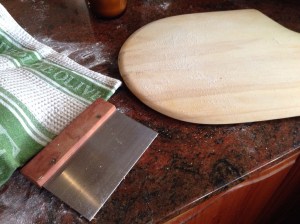
Bread paddle

To get my rolls into the oven, I scatter rice flour (semolina is good too) onto my bread paddle. A lightweight cutting board works, too.
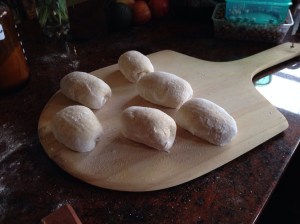
Rolls on the paddle

I put the rolls onto the paddle … and then I scoot them into the oven with my dough cutter / scraper tool I mentioned before (no photos of me doing this, as I’m not ninja enough to take pictures at the same time!).

Rolls in the oven

Close up the oven and set the timer for ten minutes. When the timer goes off, open the door and let out any steam, and turn the oven down to about 180-190 °C (a medium oven). Then I bake for a further ten to fifteen minutes. (Dinner rolls are pretty quick to bake! The times are longer if you made one loaf instead of rolls.)
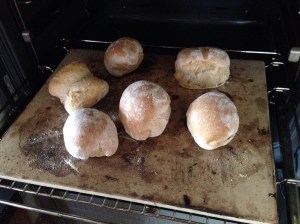
Baked rolls in the oven

Here they are at twenty minutes — look at that funny one on the left! It has popped open with the effort of rising. šŸ™‚ See how much difference in size there is? This is called “oven pop”. You get more “pop” if you transfer to a hot stone, than if you use a cold tray inserted into your oven.


All done! I served these with carrot and lentil soup. They have a wonderful smell about them – almost like a sourdough, because they have a faint yoghurt-aroma. Quite like what Naan has (which is made with actual yoghurt), only more subtle. Yum!
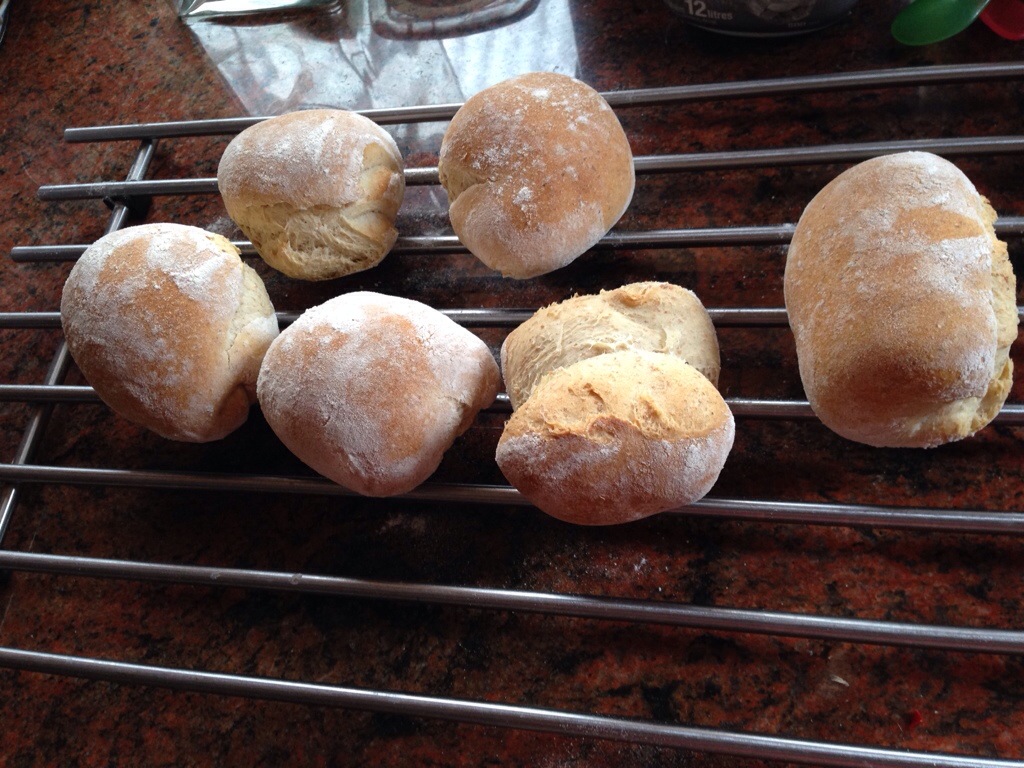
Rolls cooling on the rack
Yum, yum, yum.

Autumn garden gallery

It has been very wet here over the weekend, with a last hurrah for summer. I think we may have received much of our rainfall for all three months in that last weekend! Well, that’s a bit of an exaggeration, but it was wet, wet, wet.

And cold! I feel like Autumn snuck in a little early. šŸ™‚ Here are some pictures of the garden this morning, after all the rain.

Nappy leaks: getting to the source

A few weeks after making my two new wool nappy covers, I found that Evie was constantly having nappy leaks. One moment she is standing there, looking suddenly focussed, the next a great flood of wee comes down her leg. “Poo-poo!” She announces, and I sigh.

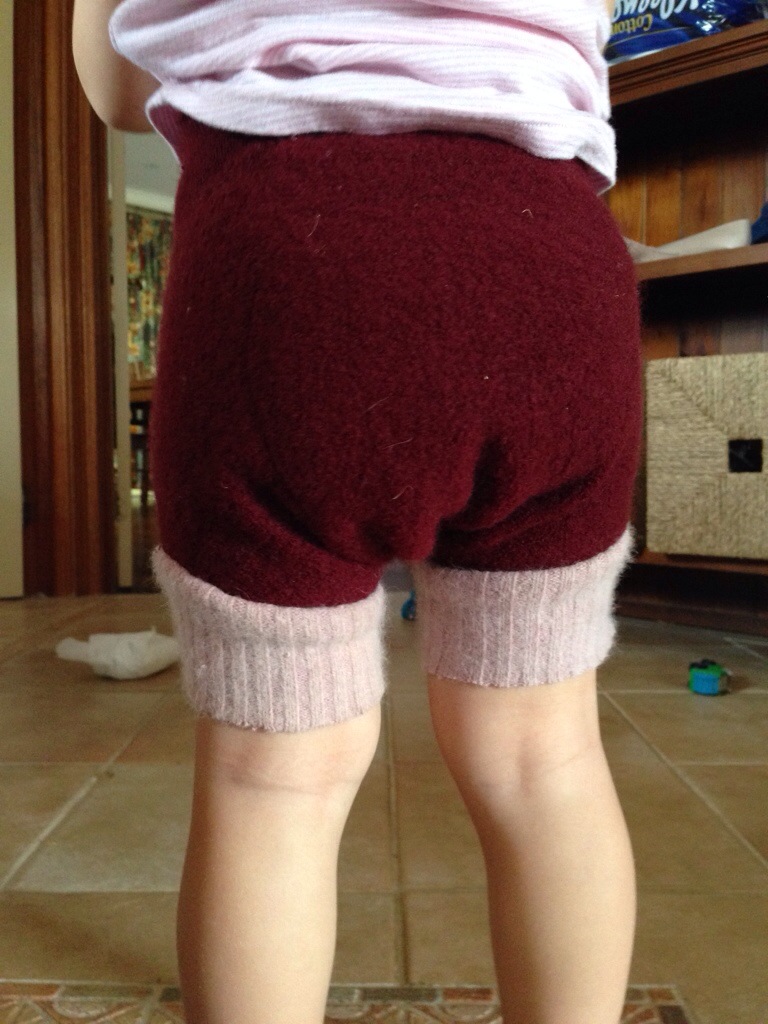
Cutest wooly nappy bottom ever!
Cutest bottom ever!

I was pretty disappointed, and I blamed my new nappy covers straight away. That was a bit unfair, though, because when I switched over to my old covers, the same thing happened. Frustrated and defeated, I tried disposables for a while.

And then … the same thing happened! Well, not as frequently, and mostly at nap time. NotĀ every time. Clearly I needed to actually understand what was going on, instead of just giving up!

Here are the symptoms I noticed as I cast about looking for the problem:

  • Between enormous floods, the nappy was dry (for like … five hours and more!)
  • When the flood happened, the top of the nappy was also dry
  • Once when a leak occurred in a disposables, the inside …. was dry. Ā (huh?) This was the only time a disposable leaked when she wasn’t napping
  • Whenever a disposable leaked at nap time, it was soaked, soaked, soaked.

So something was going wrong in her nappy world, and it was up to me to find out what!

First up, I tried adjusting her new nappy covers. I’d noticed that without any elastic at the waistband, that the cover would sometimes ride down, causing looseness around the leg area, and exposing some nappy at the waist. Maybe the leaks were because the nappy wasn’t catching the wee at all?

Okay, no change there. This didn’t surprise me a whole lot, but since the nappy inside wasn’t particularly wet I thought it must be some kind of containment problem.

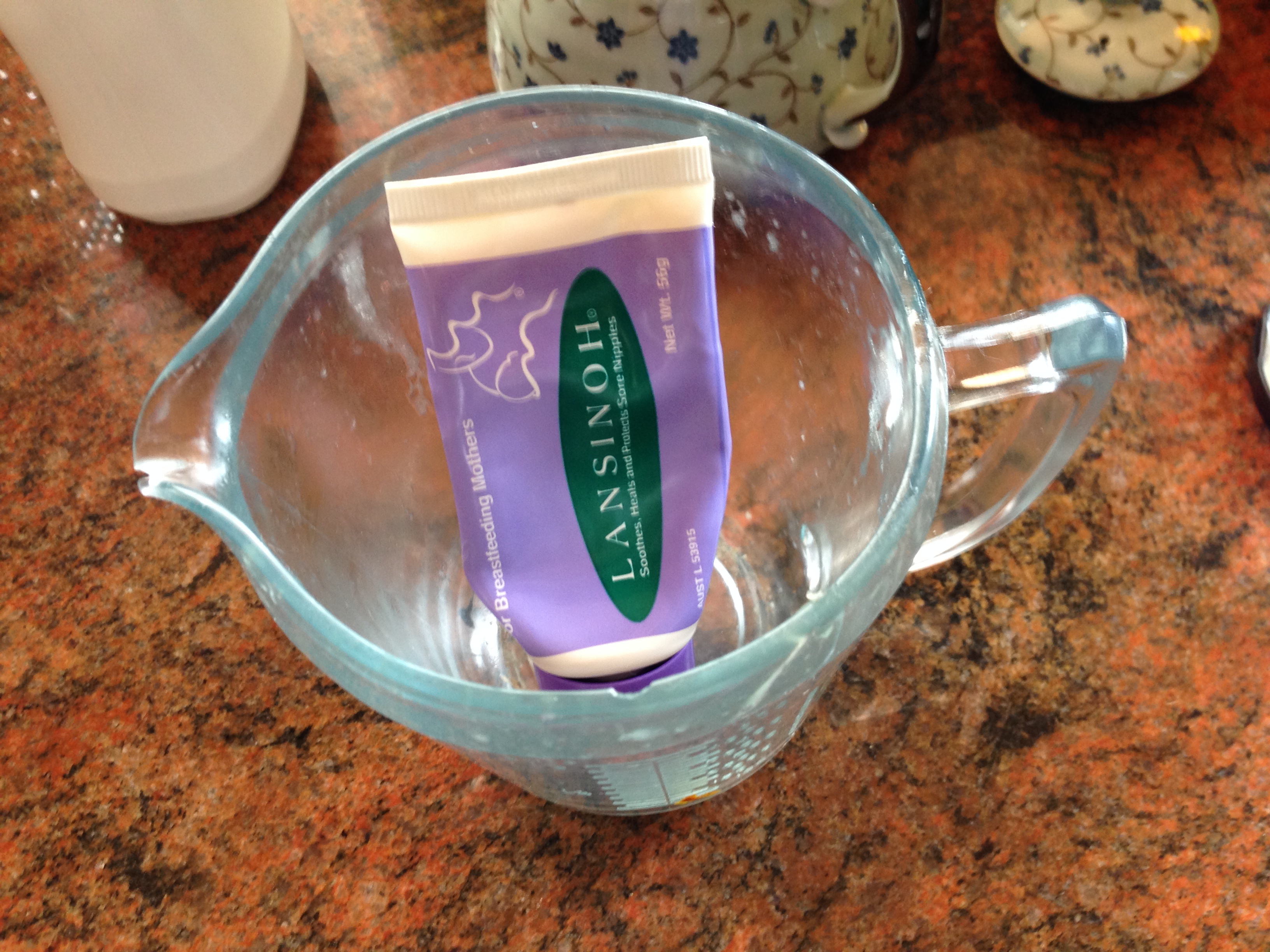
Heat a tube of pure lanolin
Pure lanolin

I tried re-lanolising the covers, again with no effect (I will post soon about how to do this). Given that the disposables were also flooding out sometimes, I didn’t have much hope of this option.

With no real idea what to do next, I turned to the internet. Good old internet, it won’t let me down! Sure enough, there is a lot of information out there about why your cloth nappy might be leaking. Turns out that wool covers are one of the better options for preventing leaks, so I was a bit miffed that I was having more problems with wool than with a disposable!

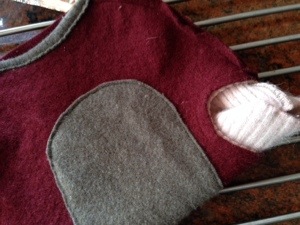
This is my favourite cover now

But my reading led me to the concept of a “compression leak”. Basically, this happens when you get a big build up of wee in part of the nappy, and then (for a bunch of different reasons) it can come out. That sounded exactly what was happening with the disposables at nap time. Basically, a lot of wee would accumulate in one spot, and then squeeze out like a sponge when she rolled over! (Yeah, ew.)

This seems to be linked, apparently, to a really heavy wetter.

Bing! Heavy wetter sounds plausible! I think Evie is at the point where she could toilet train, if I had the stamina for it right now. She holds onto her wee forĀ hours, and then it all comes gushing out at once. And she tells me that it came out! (Yeah, it’s a glamorous life.)

So basically, the nappy I was using inside the cover was not enough to contain the big wee. I had been looking in entirely the wrong place, fiddling about with covers.

It took me a bit to really trust this, because the upper part of her nappy wasĀ bone dry when this happened. It seems counter-intuitive, doesn’t it? Surely if the nappy is still dry, it can absorb more liquid? But no, apparently not if it comes out in one enormous gush! I think the take-up rate in the cotton flat is just too slow, so the bottom of the nappy would get soaked and then start leaking, but there was no time for the moisture to “wick up” into the dry upper part of the nappy.

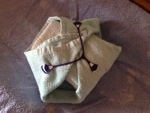
My solution turned out to be adding another flat nappy inside the cover. This one I just fold as a basic pad so that I get the most fabric under her bottom as I can manage, without turning her walking gait into “waddling sumo-wrestler”. I place this on top of the previously insufficient nappy pad, and really strap her into it. Thank goodness for the Snappy! I can’t imagine doing this with safety pins. Especially when she’s wriggling!

The new nappy covers go on over the double nappy just fine, so I’m glad I made them a little roomy. It doesn’t look insane, and she doesn’t seem to feel any discomfort. Who knew it would be that simple? I’m wondering now whether I really need a whole extra nappy, or if a half one would do. I might try cutting one up into two pads and try it out. šŸ™‚

For now I’m back in happy nappy mode. The bucket sure fills up fast using two nappies at once! But it’s a relief to have proper containment again at last.

Scrappy Toy Tea Bags

I didn’t think I’d have anything to show for Finish It Up Friday, but at the last minute I’ve pulled it out of the hat. Or perhaps, the tea box? šŸ™‚

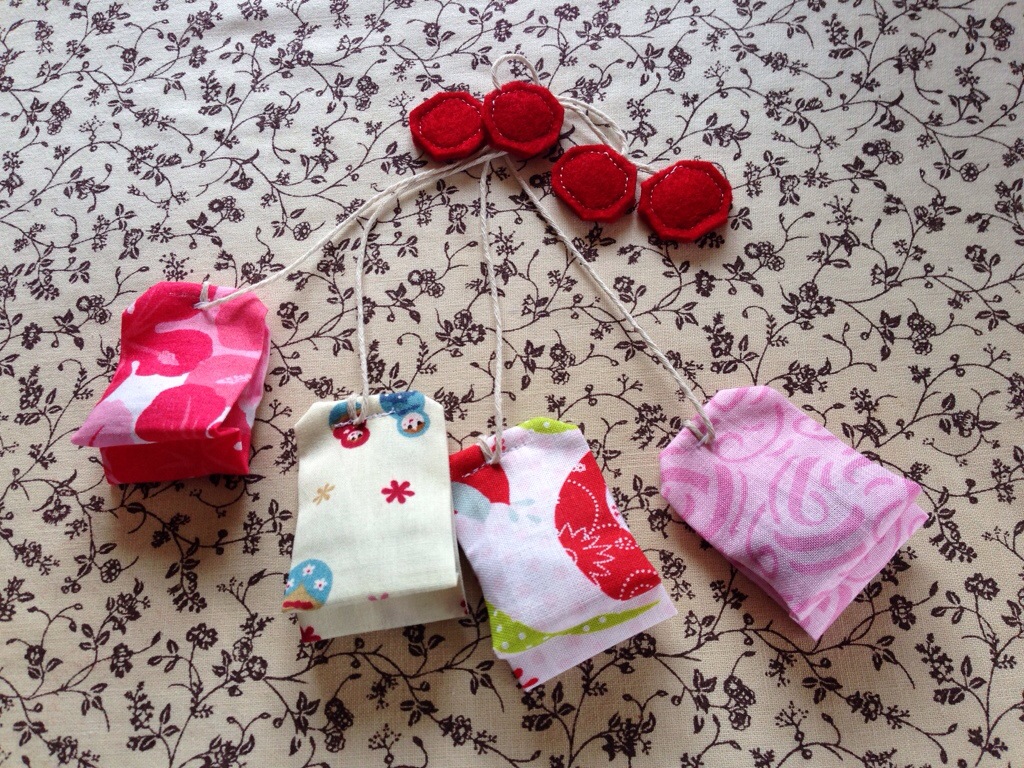
Here are some lovely tea bags, destined to be gifts for my daughter (the pink ones) and my youngest niece (the purple). How sweet are these?

I was inspired by some fantastic felt food I saw last Friday, and I did some more “research” on Pinterest and Google during the week. Wow, there are a lot of felt food ideas! I wanted to concentrate on tea bags first, however, so after a brief foray into some awesome sliceable cakes, I firmly set myself the task of making a prototype.

That was last night, and I was a little disheartened. At this point my very helpful and understanding husband discovered these awesome tea bags, and I was ready to try again. What a completely excellent idea to use a real tea bag as a pattern! I wish I’d thought of it. Here I was French seaming and messing about when it turns out the “real” tea bag is the simplest trick of all.

How to do it

Take one scrap of fabric (colourful, or plain muslin) that measure 6″ x 3 1/2″. Sew the long edges together with a 1/4″ seam, and press open.

Seamed tube
Tube with seam ironed flat

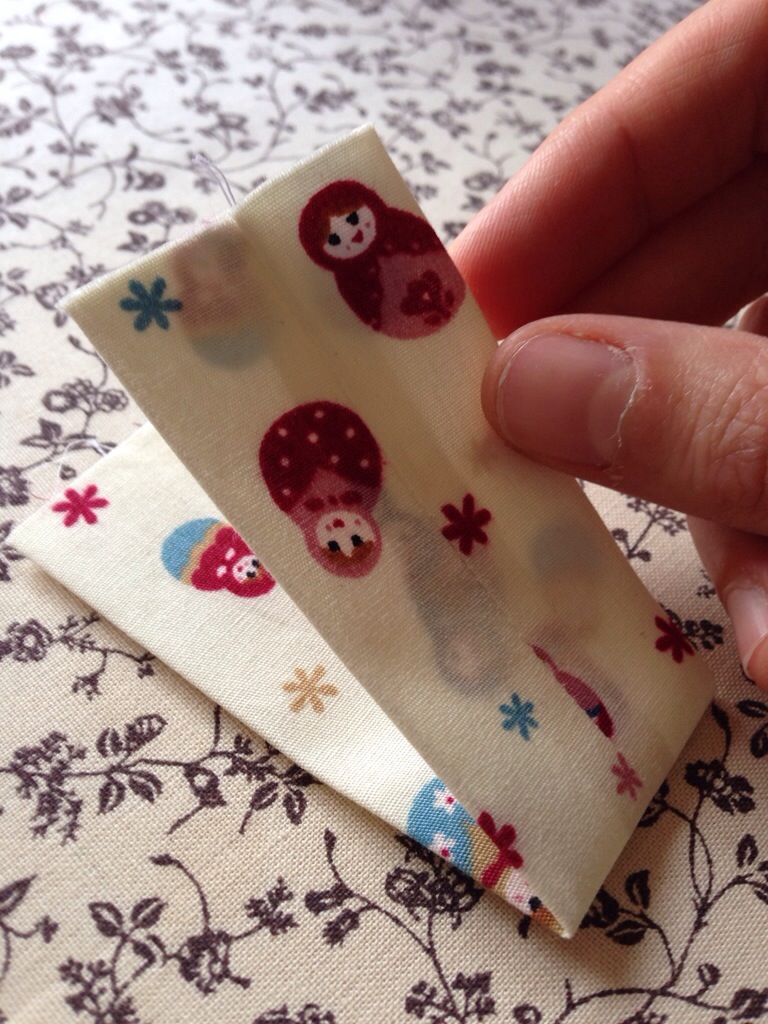
Turn the tube inside out, and press again. Then fold the flat piece in half (so the seam is showing). Press this firmly and let it cool.

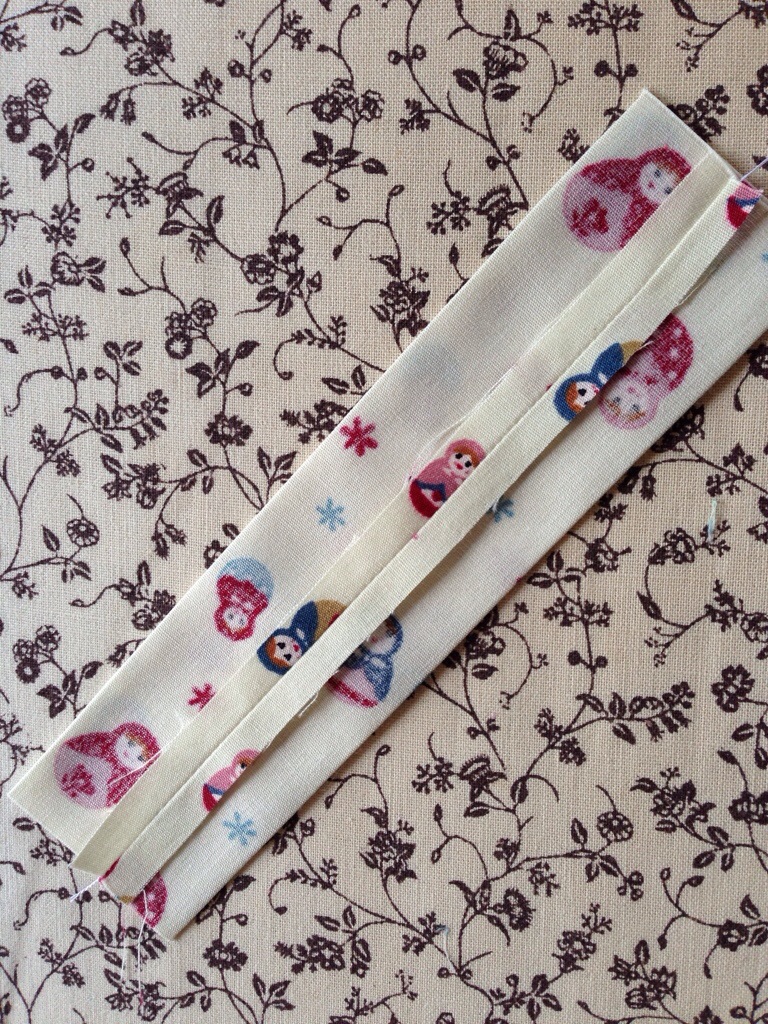
Fold tube in half and press with seam facing out
Fold the tube in half and press. Seam facing out!

Now you fold the tube back on itself so that you have about 1 cm (or a fingernail width) of pleat. Do this to both sides so that the seam is now on the inside of the tea bag, and you have a little fold at the bottom that you can use to stand the tea bag up:

Looking pretty good! It would look even better with some fake tea, though! I cut up a bit of dark green felt (I didn’t have any brown) and poked it through a funnel right into the bottom of each pocket. It was a right pain to do this without the funnel, as the felt just sticks to the first fabric it touches.

Stuffing with fake tea
Stuff each pocket with fake tea

I figured that if the tea bag gets wet (and with Evie, this is almost a certainty) that acrylic felt would dry out quickly enough. And although it may bleed green colour into the cup, that would just add to the whole tea bag experience, am I right? šŸ™‚

Next up is the slightly fiddly bit: closing up the bag. Clasp both tea bag pockets together, trim one side by 1/4 ” (just to remove some bulk) and then fold the corners of the longer edge over, and in towards the centre (purple now!):

Fold the corners in
Fold the corners towards the centre line, and press

My real model tea bag (Twinings) is paper and doesn’t take much wear and tear, so it just does one more fold and calls it done. But the toy one will certainly be pulled and jiggled until it falls apart, so I made sure to fold that top edge over twice to hide the raw edges, and to catch a jiggler string at the same time.

So, the first top fold:

Fold up the tip
Fold and press the tip

Lay a piece of string on top of the fold, and stitch it down with a wide zig-zag stitch:

Secure string
Secure the end of some string to the fold using a wide zig-zag stitch (like a staple)

Now fold again, making sure the thread is tucked into position over the top of the tea bag and down the other side. I stitched on the “good side” of the tea bag (where the string was hanging down) to make sure I caught the string properly.

To make the jiggler I just used a piece of felt, folded in half and edge-stitched to enclose the knotted string.Ā I like this jiggler so much better than my first attempt! Wrestling with the folded fabric, and the iron, took waaaay longer than I needed to be spending. The felt jigglers, on the other hand, were quick to sew because there were no raw edges to fold away! Win.

New felt jigglers
The new felt jigglers next to the old prototype one. They don’t look dodgy at all!

I’m sure my daughter and niece will enjoy taking tea with these little tea bags. Now I need to make some felt cookies to go with them! šŸ™‚

Linking up to Crazy Mom Quilts, and TGIFF šŸ™‚

Orange Infused Vinegar

I have discovered a great way to make some great smelling cleaning products, using ordinary white vinegar, and orange peels.

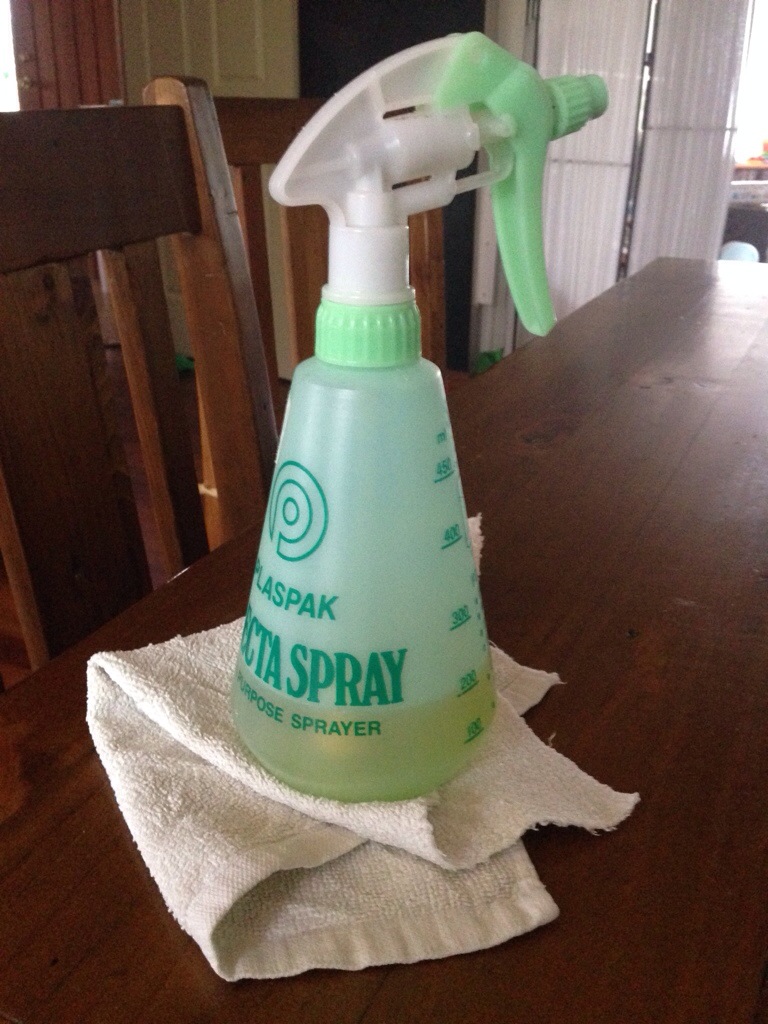
Spray bottle with vinegar
Orange-scented vinegar as a simple glass cleaner

Cleaning with vinegar is nothing terribly new: there are hundreds of recipes and creative uses for this staple cleaning product. I think the most straight-up useful way is as a glass cleaner. Just squirt it through a mister onto glass or a mirror, and wipe it away with an old rag cloth.

But the smell! Pew, I was initially really put off by the smell of vinegar in the room after I had cleaned. What’s a girl to do?

Make orange-infused vinegar, of Ā course! I can’t believe how effective andĀ easy it is to turn plain old stinky vinegar into a refreshing cleaning liquid!

How to do it

  1. Get a bottle (I use glass) and mostly fill it with cheap white vinegar.
  2. Cut up an orange, or two, and eat it. Yum!
  3. Stick the orange peel into your glass jar
  4. Put on a lid, and leave it on the kitchen bench for a few weeks.

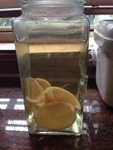
Over time, the vinegar will leech the colour from the orange peels, leaving a slimy looking peel, and yellow coloured liquid. When you think it has leeched for long enough, empty the vinegar into a bottle and store it: I put mine back into the original bottle, or into a spray bottle. I also combine it with Baking Soda (Bicarbonate of Soda) in various ways to clean surfaces, toilets, ovens, toasters, my kettle … the list goes on and on.

It’s so much more of a pleasure to clean with an uplifting orange-fresh scent. It takes the typical home-made cleaning recipe from a bit dodgy and home-grown to a “proper” product. This is how it’s meant to be done! šŸ™‚

Octopus Tutorial: Legs Alive!

Welcome to part two of my tutorial series on constructing an Octopus Softie! We have already constructed the body, and now we are going to make some plaited raggedy legs. šŸ™‚

In the last tutorial I made some suggestions about fabrics for the legs. If you haven’t already sorted this out, go choose some long scraps from fabrics that are slippery (like a nightgown), or loose weave (like cheesecloth), or stretchy (like a t-shirt). For each leg you will need three strips of fabric, about two inches wide, and about 18 inches long.

Strips grouped into threes
Fabric strips grouped into threes

Here are a bunch of scrappy strips that I have grouped up into threes. Note that the colours are reasonably similar in each group – low contrast. Previously I’ve used some wildly different fabrics and I’ve found that the finished plaited legs look a bit too scrappy.

For each group of strips you will need to prepare your fabric, and then plait it. You will need some safety pins for this step (pins will work too, in a pinch). First up, preparing:

A note on using t-shirt fabric: cut each strip across the bottom of the shirt, then give it a slight stretch along its length. You will find that the strip will automatically curl the raw edges in for you. If you are tricky, you can make one really long piece of “t-shirt yarn” using this technique.

After you have folded and pinned each strip, the raw edges are roughly hidden (at the top end). Now you need to twist each strip so that the raw edges will stay tucked away (mostly) for the length of the strip:

Note that the strip will twist on itself when you pin the end up onto the ironing board: totally normal. If you twist each strip the same way, your plaited leg will also twist. If you twist the middle strip the opposite way, you will have a flatter plait. Both look great on a softie octopus, so don’t let it worry you! I did both techniques on my legs.

Finally, you will plait the legs together:

If you are unfamiliar with plaiting, I suggest you practice on some different coloured shoelaces or ribbons first – something without twist! First take the rightmost strip, and put it over the middle one. Then take the leftmost and put it over the middle one. Then the rightmost again … you will see that the strips start to swap places and work their way left and right across the plait.

To plait the twisted strips: undo the pins you have just secured, and pull the ends away from the ironing board until the strips are unkinked. It is a little challenging to begin the plait by holding the very ends, but that’s what you need to do: keep a little bit of tension to make it easier.

Once you have plaited about a third of the way, it will start to feel easier to manage. The shorter the length you have left, the easier it will be to plait. If you end up in knots, just let go of the ends and secure whatever you managed to plait with a safety pin. Then try twisting only a short section of each strip, so you don’t have to wrestle with really long sections. You will need to stop periodically to secure your plait, and then add more twist to the remaining ends.

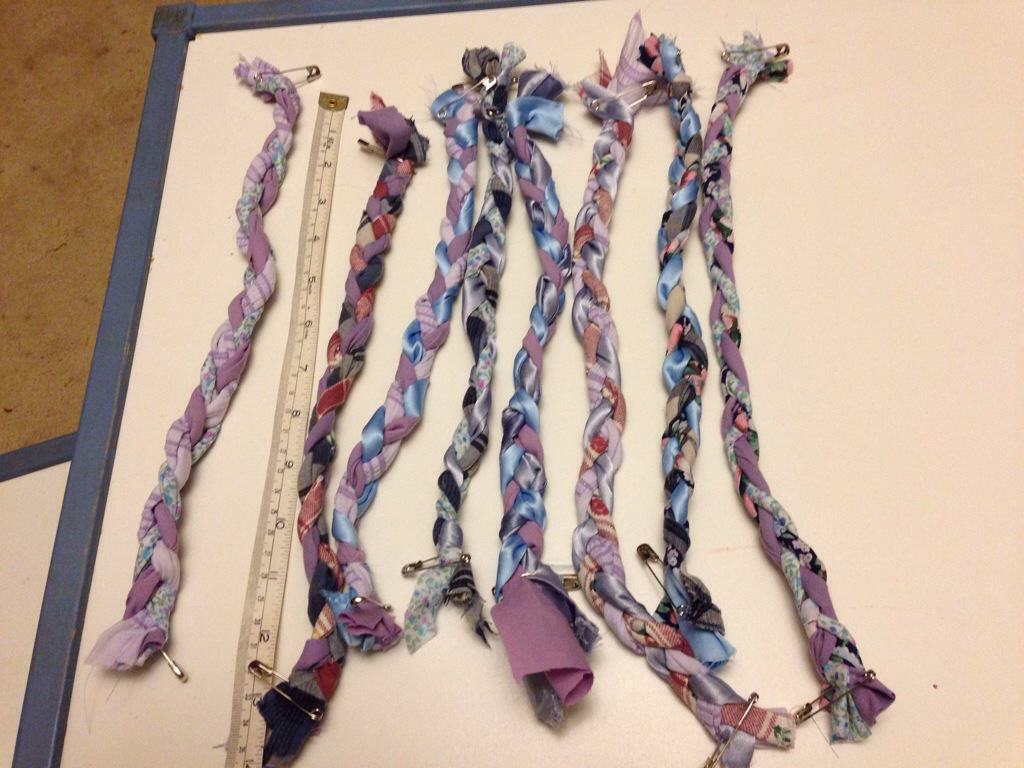
Once you have plaited all eight legs, they will come out something like this:

Plaited legs
Wriggly scrappy plaited legs

Try to keep any raw edges inside the twist / plait. You may find that it gets more ragged at the bottom. That’s okay! You can always trim off a bit of length off the plait if you feel it may unravel. Once plaited, the legs are quite long – about 12 inches.

Make sure when you unfasten the top strip ends from your ironing board that you secure the them together with a safety pin. You don’t want your plait to come apart at the top!

Your legs won’t necessarily be the same length, or even thickness. The fatter fabrics will make a shorter, chunkier plait. It’s all good, though! This just adds to the scrappiness – and the little one receiving the softie will appreciate exploring the different thicknesses and textures. šŸ™‚

Next time I’ll talk about how to add your legs on to the body.

Cleaning my Sewing Machine

I came across a blog post recently, outlining how to clean a sewing machine (which I can’t find to share for you, sorry!). I remember thinking — you need to do that? I’ve never done that!

This week, after I finished Izzy’s duffle bag and had decided to take a brief sewing break, I decided to try it out. Why not? Could be fun!

I couldn’t find the original tutorial I’d stumbled across, so I googled for a bit and settled on a Free Craftsy class called “Sewing Machine Maintenance 911“. There are some classes at the start about the parts of the sewing machine and how to start sewing, if you are a total beginner. I’m sure that would be useful to the right audience, but that’s not me, so I skipped to the end for the maintenance stuff.

I’ve never watched a Craftsy class before, but I think I like the idea! I still prefer reading a tutorial with lots of pictures, though. I certainly don’t always have time or the peace and quiet for watching videos!

This particular class had good advice on not blowing air into the machine with compressed air, which I had also read on my missing tutorial. Ā Okay, good to know. Also I don’t have any compressed air!

Here is what my machine looked like before I cleaned it:

I used the lint brush that came with the machine, a pair of tweezers, and a few cotton buds with a drop of oil on to get the dust to really stick on. And I needed to wipe the machine down thoroughly, it was pretty darn dusty in all the places where I don’t regular run my hands over! I cleaned it while I watched the class, and with Evie watching “Monsters Inc.” and it probably took about half an hour.

Check out the result:

I’m not going to say “Ewwwwww!” like a lot of these posts do, because heck, I just don’t find lint disgusting. But I’m sure it’s better out than in! šŸ™‚

Morning walk in the garden

Walking through the garden yesterday morning, there are a lot of new crops coming along, and a couple of problems to deal with:

We shall have to do something about the citrus: the Orange tree needs immediate attention, I think. Then there is also this guy:

This goanna sometimes visits our chicken coop looking for eggs. I haven’t seen him since we put the new orchard walls up — I was hoping he wouldn’t find a way in now. Obviously he can still get into the area, but he has a harder time getting out!

He got pretty thoroughly confused inside the coop (as usual) but eventually found the open door. I had already evacuated the chickens from the area, so they were safe off eating borage seedlings on our driveway (cheeky chooks!). This time I had to open the gate at the top of the orchard to let him go on up the driveway and away from me and my scary broom. Then I herded our chooks back into their enclosure. Phew!

I think the wooden fence line in the orchard might need work at ground level where there are some gaps big enough for the goanna to sneak in. He only finds the gaps when he isn’t panicking!

And he hasn’t found our eggs. šŸ™‚

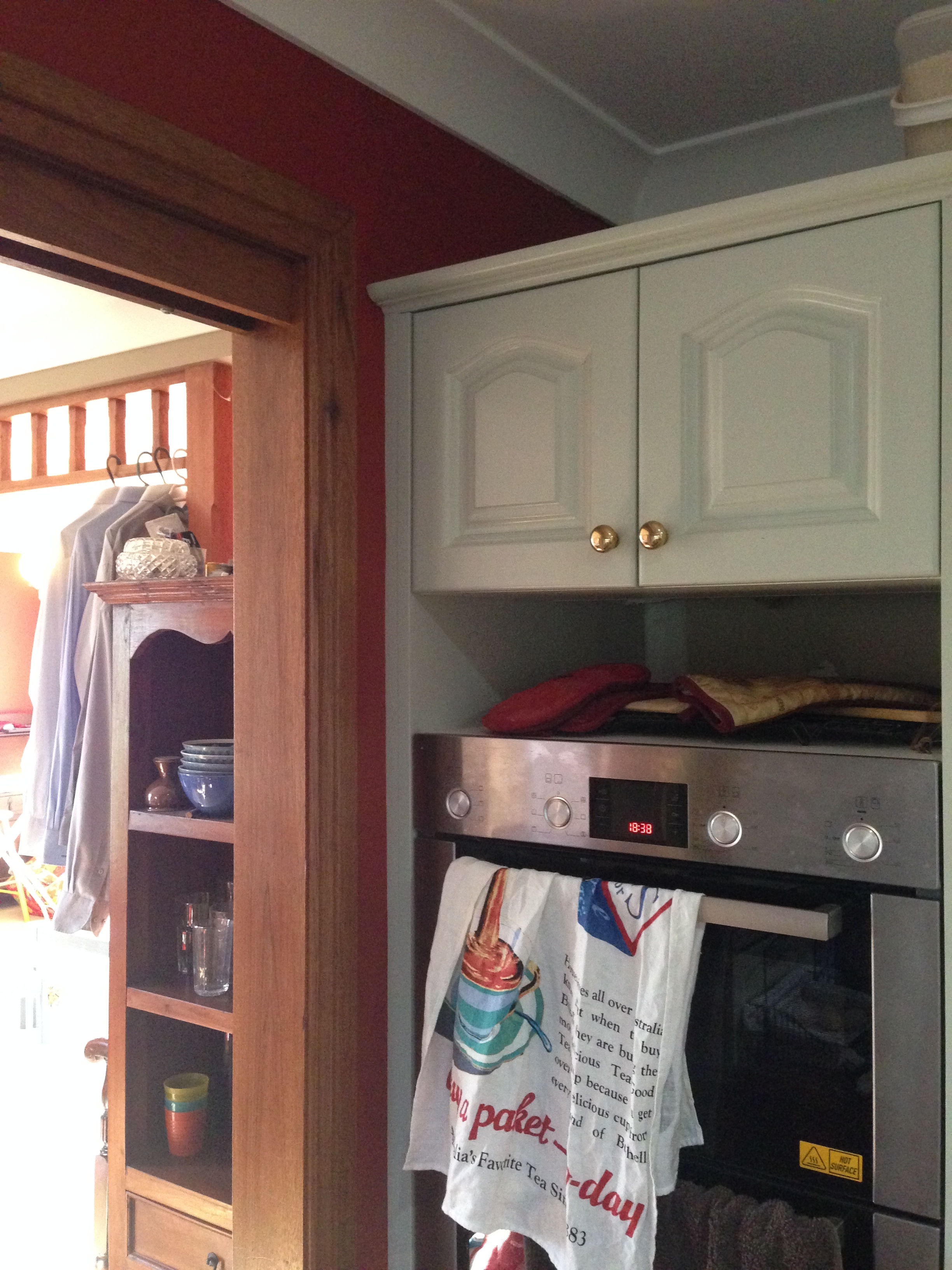
Kitchen Redo: Phase Two Surprise!

Last year I knocked over painting one wall of cabinets in the kitchen, and pretty soon I was ready to get on with phase two: painting either the cabinets under the bench top, or the ones over the stove.

I took a few weeks to mull this over, as both were significantly harder, logistically, than the ones I’d just done. If I chose the under bench ones, the kids were going to be able to get into all my stuff, and fencing off the large cabinet boxes could be awkward. The overhead cabinets avoid this, but there’s a lot of glass to mask off, and the whole cabinet would be exposed to steam and grease from the stove area underneath for the duration of the drying time …. hmmm!

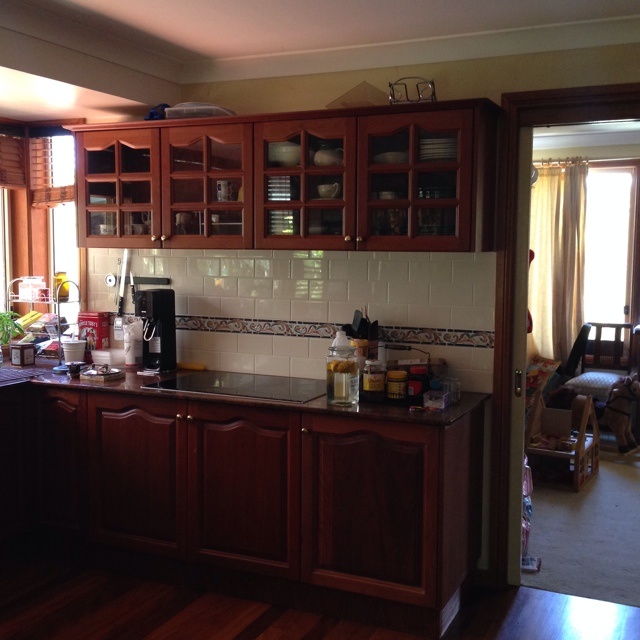
I cast my eye over the stove area to focus my pros and cons:

Kitchen Stove Area
Kitchen Stove Area

The more I looked at this space, and how we used it, the less keen I was to start working on those overhead cabinets. They were storing our fancy plates, and the teacups. Above the cabinets we were collecting junk, plus a whole lot of greasy dust. HMMMM.

Noink! Just after Christmas I decided (after hinting to Stephen a bunch of times) that really we could live without that cabinet at all, and move it somewhere else in the kitchen. So one afternoon Stephen came in from the garden and found me up on the bench, knee deep in plates, and wielding a screwdriver!
I don’t recommend taking your husband by surprise like this. He wasĀ not impressed. Although we were on the same page about the cabinets (in the end!) I had not sufficiently prepared him for imminent DIY chaos. And the holes in the wall!

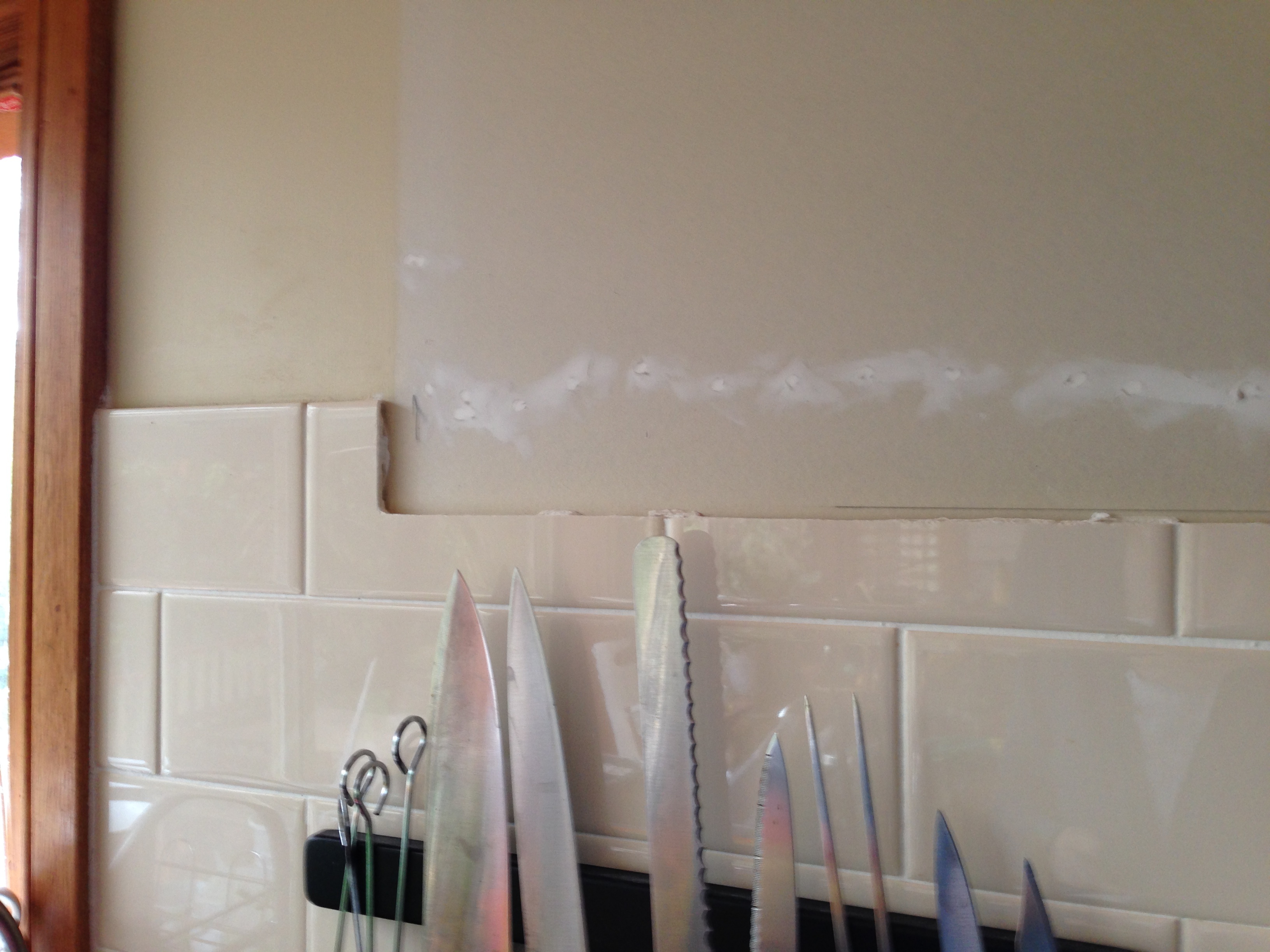
Holes in our wall
Holes peppered the wall where the installers had tried to find the stud!

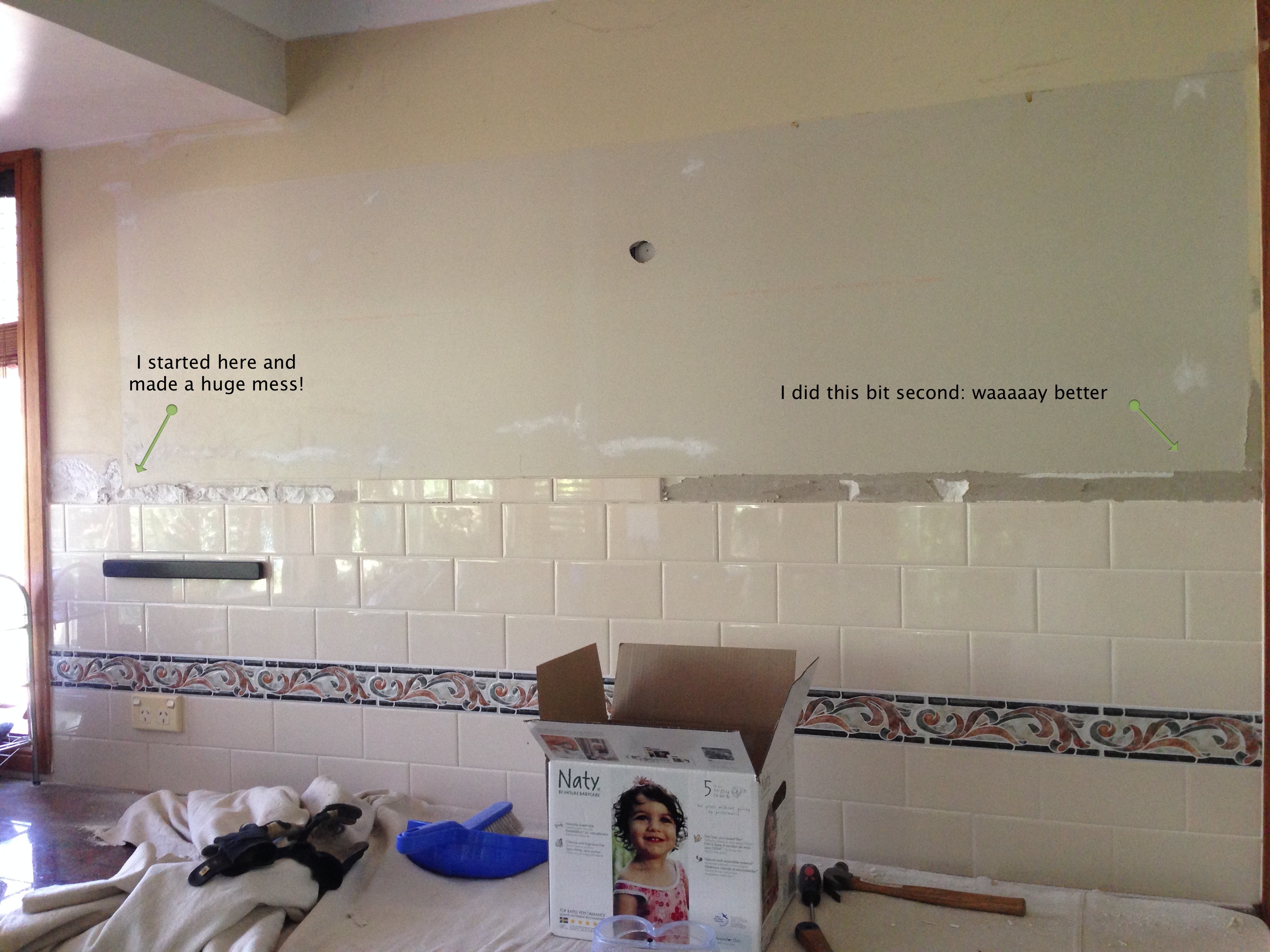
I promised to make good as quickly as possible, which made me gulp a little – I’ve filled countless screw and nail holes, but never patched a hole that large before! There was also an ugly row of part tile to remove, which made me wonder what kind of mess I was really about to make! I needed to get some research done ASAP and at least cover those holes so the steam didn’t get into our wall.

I stuck a plastic bag over the big hole in the wall, and filled the little “bullet holes” with ordinary Polyfilla as a quick fix so that steam from the stove didn’t get into our wall cavity. Then I researched how to remove tile, since I figured I’d be making some mess with the drywall, and I may as well do the real patching all at once, after the jump, so to speak.

Prising the tile off was a heart-in-mouth experience, let me tell you! I used a utility knife with a wide blade and a hammer to knock it between the tile and the wall (like using a chisel). The first three tiles made a terrible mess. Clearly I was doing it wrong!

Tiles removed
Tiles removed on the top row, with varying success

I started again at the other end, and changed how I was inserting the utility knife. Instead of trying to force it between the tile and the glue, I aimed to go between the glue and the wall: much more successful! I got the rest of the row off with minimal damage to the drywall.

Now with some big gouges to repair, I looked up how to fix drywall. I decided to use plasterer’s paper over the top of some drywall compound, as this would enable me to fix that long gouged section. I also bought a patch kit for the big hole, but I kept it in reserve in case my technique with the paper was shonky (my reading led me to believe that paper is harder to DIY than the kit).

I could go into huge detail about the plastering, but I don’t have any close up photos, and I want to skip ahead to the big finish. šŸ™‚ (There is more drywall repair in my immediate future, so I will show you this process when I get around to it!)

Let me show you what it looked like all plastered up:

Drywall repaired
Plastering finished, and the large hole patched over

All this work took me only a couple of days, and I had a much happier husband on my hands. He realised I wasn’t going to leave us in hole-in-wall hell for weeks! šŸ™‚

After that, I was back in my comfort zone. I just needed to prime the wall (there was unpainted drywall exposed, which requires priming, and also the plastering needs primer to seal it too):

Wall primed
Wall painted with Dulux Water-based primer

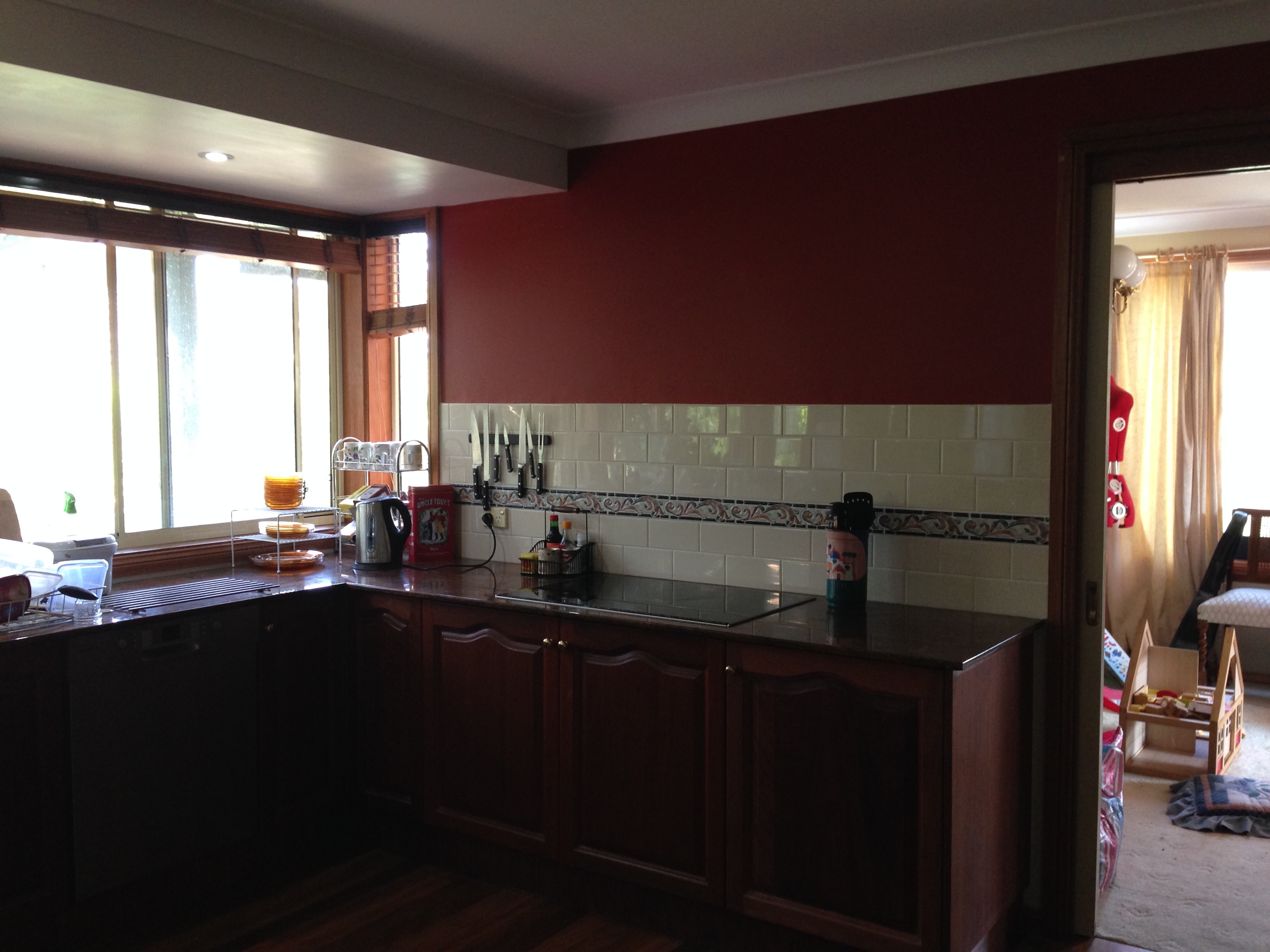
And then choose a paint colour and paint it! The colour choice was hard this time. I really loved the brightness of having that dark cabinet removed, with the light bouncing around the ceiling area and down onto my stove. I didn’t like the neutral colour we’ve used elsewhere, though, because it doesn’t match well with the green colour on the cabinets. Solution:

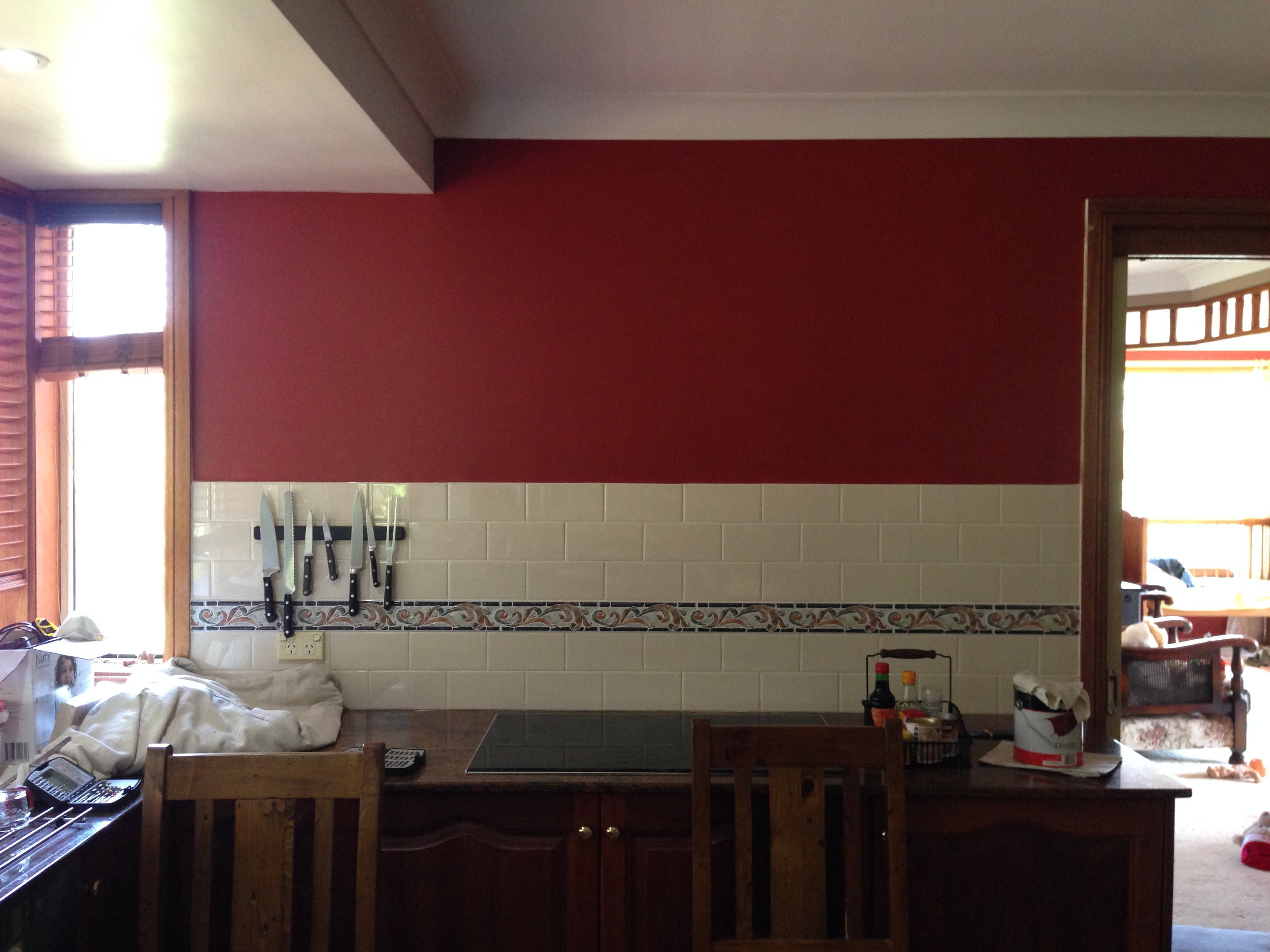
Red painted wall
Hello, Carmen Miranda red!

The final result is the space feels a lot more open (several guests have commented on this, in a tone of surprise). Waaaay more light falls onto the stove area now that the overhead cabinets are no longer blocking the ceiling down lights, and the natural light from the window. I’m also really enjoying cooking and cleaning the backsplash (“enjoying”) without banging my head!

Red painted wall with green painted cabinets
Let me tell you this spot over the oven cabinet was hard to paint!

Above you can see the area where the new cabinet and wall colours intersect. IĀ love this combo.

Here is a fun slideshow taking you through the whole thing, double quick time šŸ™‚

This slideshow requires JavaScript.

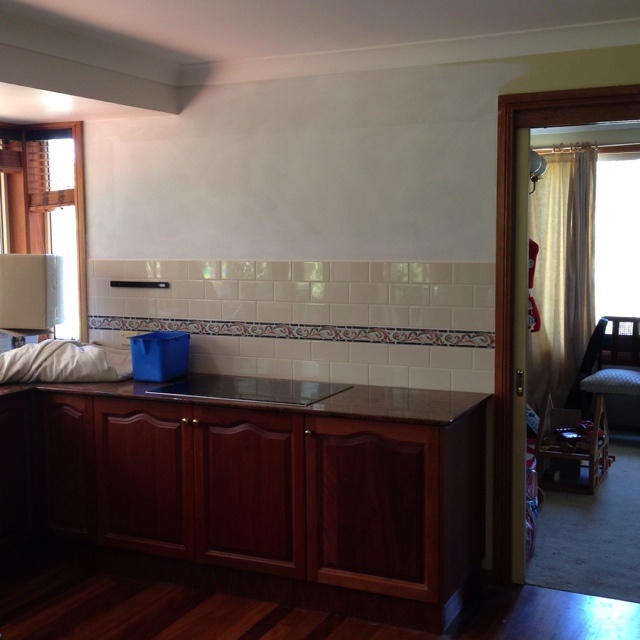
And once it was all tidied up, and “styled”, as they say:

Finished kitchen wall
By late afternoon the kitchen was tidy again.

Shameless brag: Giraffe Cake :)

It was Isobel’s birthday yesterday, and today we are having a party! This is the first time I’ve tried making a fondant cake, and hey, all that play dough practice has paid off!

I made my own fondant, and it was really easy to work with – not stiff at all. I also bought packet fondant just in case, but I’ll save that for a rainy-day activity instead.

I even made a fondant giraffe instead of using one of Izzy’s many ornaments. Cake win!